
Ahead of AAPI Heritage Month, REACH Coalition Begins 2026 AANHPI Curriculum Bill Push in Albany
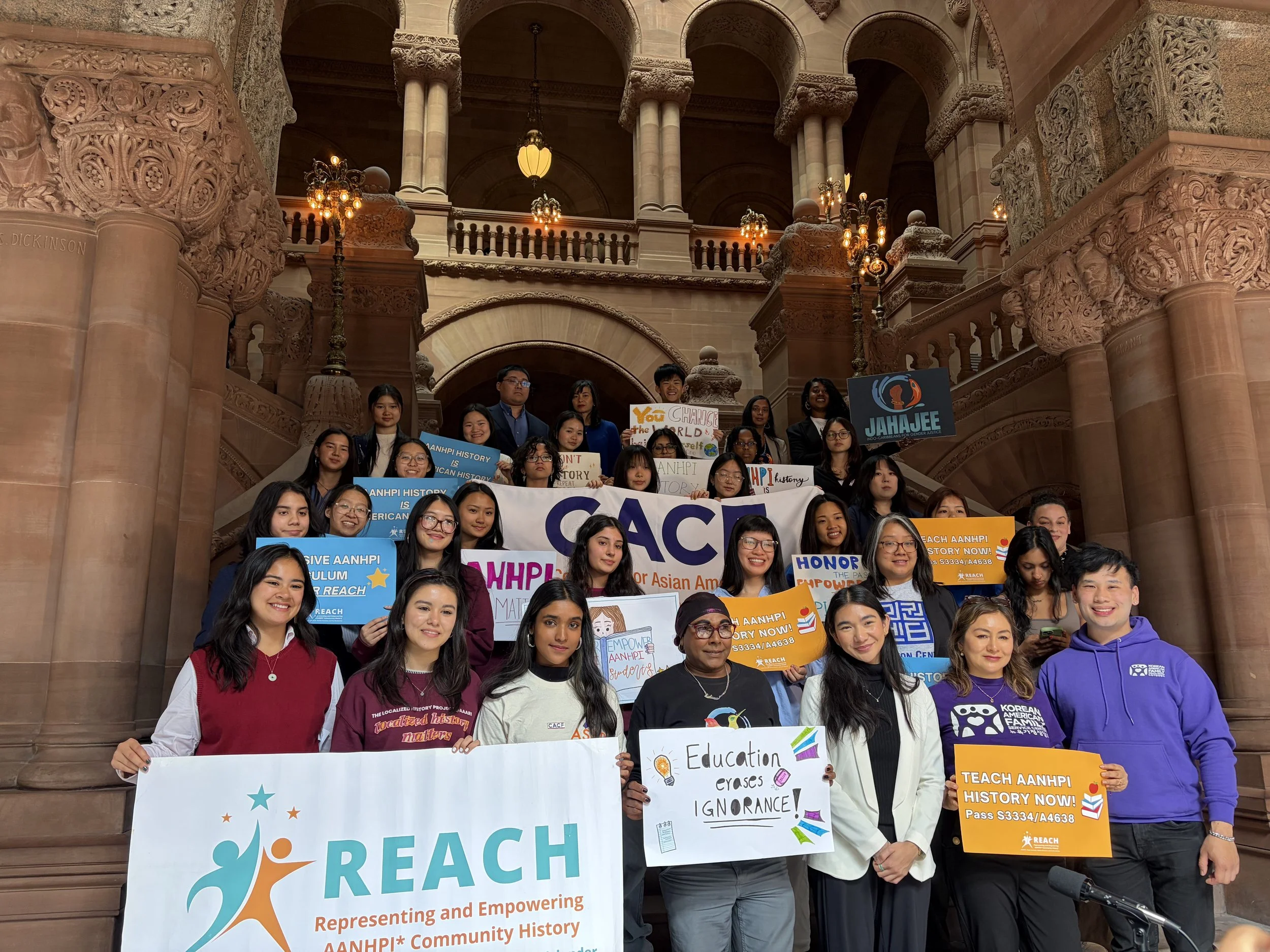
New York, NY (April 21, 2026) — April 21, 2026 (Albany, NY) — Today, the REACH (Representing and Empowering Asian American, Native Hawaiian, and Pacific Islander (AANHPI) Community History) Coalition and its member organizations rallied alongside community members, educators, students, and advocates on Albany's Million Dollar Staircase to urging passage of the AANHPI curriculum bill (S3334/A4638) as part of REACH's annual Advocacy Day. This legislation would ensure Asian American, Native Hawaiian, and Pacific Islander history is taught in public schools across New York State.
Sponsored by Senator John Liu (D-16), Senate Bill 3334 and its companion Assembly bill 4638 sponsored by Assemblymember Grace Lee (D-65) has seen growing support over the years.
The Advocacy Day builds on momentum from last year’s legislative win, when the AANHPI Education Equity Act was signed into law. The AANHPI Education Equity Act marked a key step toward understanding how AANHPI history is currently taught across the state. With that groundwork in place, the coalition is now pushing for a $500,000 investment in this year’s State Budget to fully support the AANHPI Education Equity Act’s Advisory Council, and the development of a comprehensive, statewide curriculum in line with state standards and the State Education Department’s Culturally Responsive Sustaining Education Framework.
Co-founded in 2022 by the Coalition for Asian American Children and Families (CACF) and OCA-NY the REACH Coalition is the first statewide coalition of its kind. Today, it brings together more than 60 community-based organizations and over 170 educators, students, and community members fighting for a more representative and inclusive telling of history in our state’s schools. At a time of increased political attacks on the ideas of inclusive education and social justice, it is vital that the experiences and realities of students are reflected in the curricula they study in schools.
Throughout the day, participants will meet with legislators, share their experiences, and advocate for curriculum that reflects the diversity of New York’s communities. This year, students will share micro lessons on moments of AANHPI history they hope will be taught in school once this bill passes. The coalition’s approach centers on solidarity and intersectionality, with a broader goal of ensuring that all historically marginalized communities are meaningfully represented in public education.
“AANHPI history is American history, and it belongs in our classrooms. For far too long, our stories, our struggles, and our contributions have been excluded from what students learn,” said Assemblymember Grace Lee. “The AANHPI Education Equity Act we passed into law last year was an important first step toward more inclusive education. Now we need to build on that progress by investing $500,000 in this year’s state budget for the Act’s advisory council and passing the AANHPI Curriculum Bill so every student, in every classroom, learns that our stories matter.”
State Senator John Liu, stated, “As we gear up to celebrate AAPI Heritage Month, we are reminded that the stories, struggles, and vast contributions of Asian Americans remain too often overlooked or entirely whitewashed from our classrooms. This legislation would correct that omission by giving our students a more complete and honest understanding of our country’s past, while ensuring all students are able to see themselves reflected in the history of our state and nation. From the Chinese-Exclusion Act to the wave of COVID-19-induced anti-Asian hate, teaching Asian American history is a necessity today to ensure we don’t repeat the mistakes of the past.”
Anita Gundanna and Vanessa Leung, Co-Executive Directors of the Coalition for Asian American Children and Families (CACF) and members of the REACH Coalition’s Steering Committee: “CACF is eager to work with our fellow members of the REACH Coalition to make 2026 the year an AANHPI history and civic curriculum bill is signed into law in New York State. At a time when so many AANHPI groups continue to be othered and scapegoated, CACF believes that learning the rich and diverse histories of AANHPI communities in school is a vital step to combatting both the ‘perpetual foreigner’ and ‘model minority’ myths that stubbornly persist in the United States. Public school students of all backgrounds deserve to learn the rich and diverse histories of AANHPI communities as part of an inclusive curriculum that combats the harmful stereotypes we continue to see in discourse today.”
Shreya Sunderram, Director of the Localized History Project at AAARI-CUNY and member of the REACH Coalition’s Steering Committee: “As a former NYC high school history teacher, I have seen the ways that history curriculum can either serve as sites of harm that make young people feel invisible; or history curriculum can serve as a site of empowerment. At the Localized History Project, we see what happens when history curriculum is youth driven: it becomes a site of liberatory memory work where we build connection, community, and belonging. This bill is critical in ensuring that all classrooms can look like LHP.”
Mohamed Q. Amin, Founder and Executive Director of the Caribbean Equality Project and member of the REACH Coalition’s Steering Committee: “Indo-Caribbean history is Asian American history. For two consecutive years, the REACH AANHPI curriculum bill passed the New York Senate, signaling a monumental legislative victory in creating a pathway for amplifying the diversity and intersectionality of NY's Asian American communities. New York is home to the largest Indo-Caribbean foreign-born population in the United States, many of whom live in immigrant communities like Schenectady, Richmond Hill and South Ozone Park in Queens, East New York in Brooklyn, and Castle Hill and Wakefield in the Bronx. Teaching Indo-Caribbean history is critical in honoring the legacy, struggles, and resilience of thousands of indentured laborers trafficked to the Caribbean and the double migration of their descendants who now call New York home. These descendants now contribute to the ethnic diversity and economy of New York, which fosters cultural competency, strengthens cross-racial solidarity, combats anti-Asian hate violence, builds political power, and ensures representation in public education. Asian American history matters! New York state must teach a curriculum that reflects the ethnic and racial diversity of the classrooms. In this legislative session, we call on the New York State Senate and Assembly to stand with Asian American students and families by fortifying our state to create access to equity, diversity, and inclusion through education by passing the AANHPI curriculum bill."
Simone Jhingoor, Executive Director of Jahajee and member of the REACH Coalition’s Steering Committee: “Indo-Caribbean communities, descendants of indentured laborers from South Asia, have shaped New York City’s cultural, social, and economic life for generations, yet our history remains largely absent from mainstream education. The REACH bill is a critical step toward changing this, and Jahajee is proud to advocate for a curriculum that recognizes our community’s contributions and empowers future generations. By fostering pride in Indo-Caribbean heritage and promoting empathy and cultural appreciation, this initiative enriches all students’ understanding of New York City’s diversity and our shared history.”
Richard In, Executive Director of Korean American Civic Empowerment (KACE) and member of the REACH Coalition’s Steering Committee: “AANHPI history is American history. Including this history curriculum in our schools is a necessary step in the right direction to build up a stronger and more robust education that benefits all students. Members of this diverse community have contributed to this country and fought to promote and defend the rights and privileges we all enjoy today for centuries. It is time to finally catch up with other States and include those pivotal contributions and histories in our school curriculum.”
Seema Choudhary, Director of Culture, Curriculum and Advocacy at South Asian Youth Action (SAYA) and member of the REACH Coalition’s Steering Committee: “SAYA serves a diverse group of youth in New York City, hailing from various ethnic and religious backgrounds - many of whom identify as South Asian and Indo-Caribbean. Over the course of our history, SAYA has worked to break down the “model minority” myth, and pave the way for greater attention and investments in social services for the larger South Asian community. We believe it is critical to affirm and uplift the lived experiences and unique migration stories of our South Asian and Indo-Caribbean youth. We advocate for the passage of the AANHPI curriculum bill as we know first-hand how impactful it is when young people feel seen, affirmed and uplifted in their identities. By passing this bill and ensuring that our diverse AANHPI history is taught in public schools across New York State, we are empowering both AANHPI-identifying youth and youth of other historically marginalized communities to celebrate and find pride in their unique identities.”
To be connected with a member of REACH, please email CACF’s Senior Communications Coordinator Lakshmi Gandhi at lgandhi@cacf.org.
###