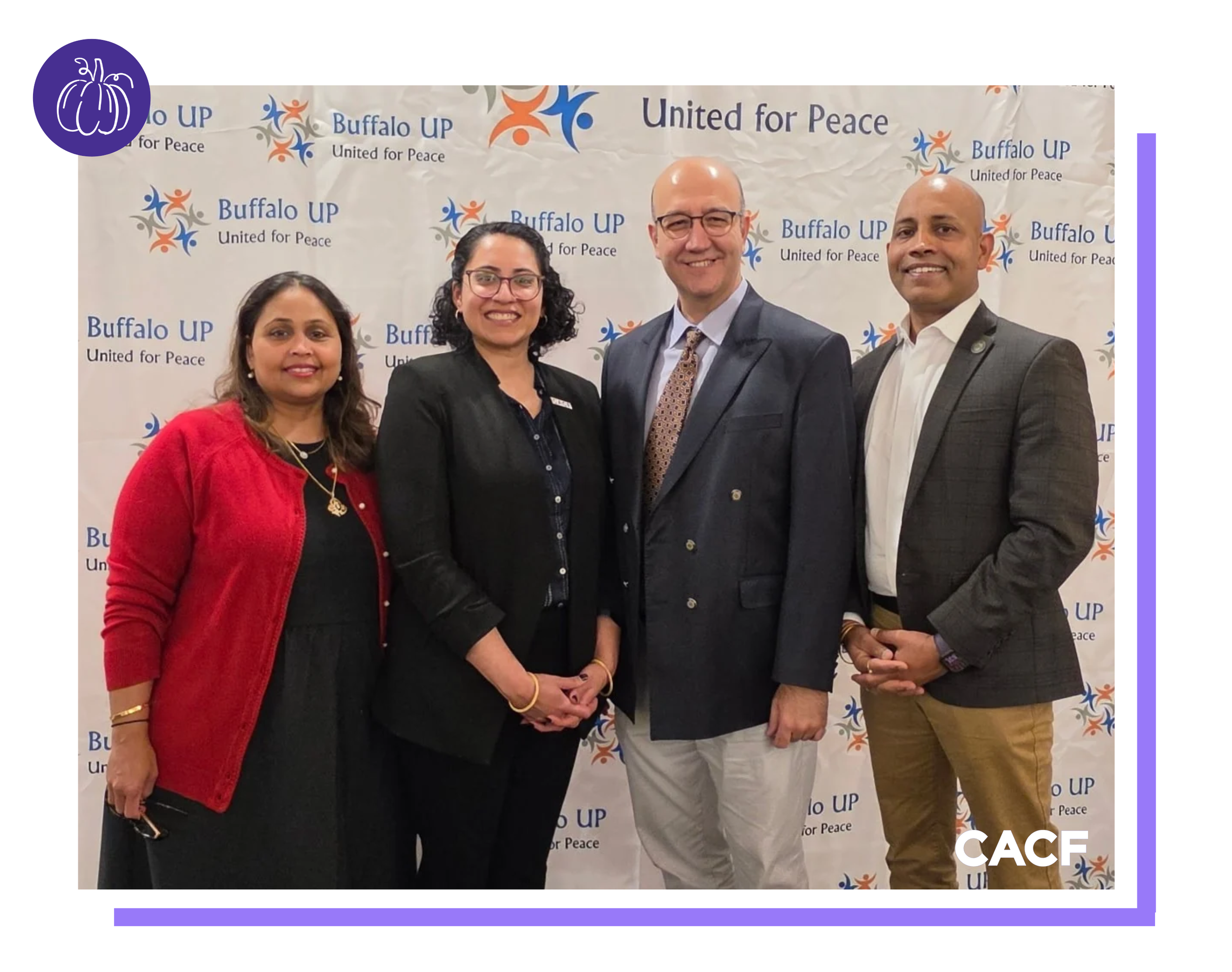
CACF’s Co-Executive Director Anita Gundanna (center) with from left: Prachee Samant of Senator Jeremy J. Zellnor’s Office, Buffalo UP President Mustafa Gökçek, and Governor Hochul’s Director of Asian American Affairs Sibu Nair.
Buffalo, New York (November 19, 2026) — CACF’s Co-Executive Director Anita Gundanna delivered the following keynote address at Buffalo United for Peace (Buffalo UP)’s annual Pre-Thanksgiving Dinner on November 18.
Read her full remarks below:
Solidarity: Building Something More Powerful Together
Good evening, everyone.
It is wonderful to be here in Buffalo, surrounded by the warmth of so many people who care deeply about our communities. Thank you to the community leaders, nonprofit partners, advocates, elected officials, and all of you who give your time, energy, and hearts to making our communities stronger.
And a very special thank you to Buffalo United for Peace for inviting me here, and to everyone who helped make this event possible.
As we gather just before Thanksgiving, I find myself reflecting about what it really means to come together. It’s not simply to share a meal and wonderful company, although that is definitely lovely. But it is also important to reflect together on something very fundamental: that we cannot build a strong community alone. And that we can only create lasting change together.
Those beliefs are at the heart of the Coalition for Asian American Children and Families, or CACF, which I have had the honor of co-leading for almost 10 years now.
CACF works to unite community organizations, young people, parents, and allies to build together an Asian American Pacific Islander community that is too powerful to ignore.
CACF has been working now for 40 years towards our mission to create equity and opportunity for marginalized AAPI children and families – those who struggle the most. We envision a future in which all New Yorkers, including our diverse AAPI communities, can thrive and have the opportunity to live with dignity, safety, and possibility.
Achieving that vision requires us to advocate – for better policies and accessible government services and programs, and for stronger community organizations - the backbone of our communities. It also requires us to create pathways to grow passionate advocates and aligned community leaders.
But underlying all… our work really requires solidarity. A Coalition can't move forward without it.
I want to take a moment tonight to talk about solidarity, and why it matters so much to the work of a coalition, and of building a strong and supportive community.
First, it is important to establish that solidarity is not sameness.
Solidarity does not require us to have the same experiences, the same histories, the same needs, or even the same priorities. It does not ask us to suppress any of the diverse identities that make us who we are.
All of you here today represent different communities. And at CACF we believe that our power as a coalition comes from embracing our diversity and knowing that we do not have to be the same in order to stand together. This spirit of coalition comes from the generations who came before us — people who crossed borders and oceans, built communities, cared for one another, organized, advocated, and created possibilities for the people who would come after them. They knew that together, we can create change, which none of us could create on our own.
Solidarity begins with an understanding and respect of our many and diverse identities - our varied ethnicities, religions, language communities, immigration experiences and histories. And with an understanding that other communities are also facing discrimination, exclusion, or barriers to access and opportunity in areas like health, or education, or housing.
But it doesn’t stop there. It then continues with the work to look across our differences in order to recognize what our shared struggles and needs are.
And then solidarity asks us what we are willing to do about it. It asks whether we are willing to listen, to show up, to build relationships, even to share power, and sometimes to sit with discomfort when we realize that our experiences or perspectives are not the same.
Solidarity compels us to look beyond the immediate needs or challenges facing one person, one organization or one community, and to look for the root causes and underlying systems that create those challenges in the first place.
Changing systemic or underlying barriers can really change the lives of so many.
There is a powerful example of this in the history of the Asian American movement and the broader civil rights movement that I’d love to highlight.
In the late 1960s, students of color at universities in California began organizing together under a coalition called the Third World Liberation Front.
At San Francisco State College in 1968, and then at UC Berkeley in 1969, Black, Asian American, Chicano and Latino, and Native American students came together to challenge an educational system that largely excluded them—not only from its classrooms, but from its curriculum, leadership, and the stories it told about American history.
These students came from very different communities. They had different histories, different experiences of racism, and different demands. They had their own student organizations and their own struggles.
But they recognized something important: although their experiences were not identical, they were confronting a common system of exclusion. And rather than fight those battles separately or in siloes, they chose to build together.
At Berkeley, four major student organizations—the Afro-American Studies Union, the Asian American Political Alliance, the Mexican American Student Confederation, and the Native American Student Alliance—formed a coalition and organized a historic strike.
They were demanding something big: an educational system that recognized their communities' histories, knowledge, and contributions, and gave their communities a meaningful voice in shaping their own education.
After many months and many challenges, the students won an important victory. Their efforts helped establish an Ethnic Studies department at UC Berkeley. And, at San Francisco State, the strikes led to the creation of the nation's first College of Ethnic Studies.
We learn from these examples that solidarity and a collective identity must be intentional - they often don’t just happen and they must be nurtured and built.
For decades now, CACF has brought community organizations, families, young people, and allies together to identify needs and advocate for solutions. When communities have told us that they need services in their own languages, we have worked together to make language access a priority. When families and young people have called for more equitable and integrated schools and stronger opportunities, we have organized and advocated for policy change. When our communities have been overlooked in public funding decisions, we have built a collective voice to demand that our needs be recognized.
But core to CACF, as we build our coalition, is that we continually ask: Who is included? Whose experiences are we hearing? Whose voices are missing? Are we making room for the diversity within our communities, or are we allowing the loudest or most visible voices to speak for everyone?
This is especially important because AAPI communities are incredibly diverse. Different languages, cultures, histories, immigration experiences and geographic spread, economic circumstances, and needs. We cannot build a meaningful coalition by pretending those differences do not exist.
Even as I grew up in the 80s, I didn’t think “Asian American” referred to me… I didn’t feel included in that collective identity. And I know many others may share that experience, even to this day. But if we don’t acknowledge and work to ensure that diverse communities are heard and seen, we lose the potential to create a strong and powerful coalition.
And especially as the AAPI community gains greater visibility, we must ensure that it does not make invisible, or wash out, any one community.
That is why we fight very hard at CACF for disaggregated data - from the Census to State and district level data. Granular data that can show us information about all of our diverse communities. For example, we advocate for collecting data on specific languages spoken in communities so our government public health response can actually reach those in need, or collecting data on ethnicities present in schools so our schools - including teachers, leadership, and curriculum - can be pushed to reflect their own student populations…
We want our communities to be visible—not as one simplified group, but in all of our complexity.
The power of solidarity allows us to fully hold our unique identities while also being part of something bigger than ourselves.
As a coalition, over the past several years, CACF's advocacy has helped secure millions in new government funding, along with important policy changes for our communities. Those wins did not come from one organization acting alone. They came from people and organizations coming together, bringing their knowledge, relationships, lived experiences, and determination to the table.
That is the collective power of solidarity.
And this kind of solidarity must extend even beyond the AAPI community. While CACF's work is rooted in AAPI communities, we know that our struggles are connected to the struggles of other marginalized communities - our Black and Brown and immigrant brothers and sisters. We know that the fight for racial equity, economic opportunity, safe and healthy neighborhoods, quality education, and access to public services will not be won in isolation.
I’m proud that CACF’s work has had a wider positive impact on our allies who are also supported through better data collection, language access, and funding for community organizations across NY State.
Over the past year, we’ve traveled across New York State, listening to community leaders, young people, parents, and organizations—from Buffalo to Rochester, Syracuse, Albany, Utica, Westchester, Long Island, and New York City.
And what is consistent is the desire to build bridges between communities, create pathways for leadership, and develop a shared agenda that reflects the needs and aspirations of our AAPI communities across the state.
That speaks to the opportunity before all of us both tonight and moving forward… I know that many here are already in coalition with one another.
And it is important to remember that solidarity does not require us to agree on everything. We must make room for difference. What solidarity requires is for us to stay curious, to listen, to build trust, and to keep coming back to the table.
It is a deep privilege for me to be here alongside all of you and to reflect together on the power we can have as a coalition to shape the decisions that affect our communities, and the lives of future generations.
Thank you.
About CACF
The Coalition for Asian American Children and Families (CACF) is the nation’s only pan-Asian children and families advocacy organization. Founded in 1986, CACF fights for equity and opportunity for marginalized Asian American Pacific Islander children and families through policy advocacy, leadership development, coalition building, and community engagement across New York State.
For media inquiries, please contact: Lakshmi Gandhi, CACF’s Senior Communications Coordinator, at lgandhi@cacf.org.
####